Two processes, not one
Formation is biological: microbes break uric acid down into ammonium, and they need water to do it. Release is chemistry: ammonium already in the litter turns into ammonia gas, faster when it is warmer and the pH is higher. Heat does not form ammonia. Warmth can speed the release of ammonium that has already formed while litter was wet, but heat applied consistently, from underfloor heating or warm air, dries the litter first, so little forms and little is left to release.
Stage 1: how ammonia forms
Birds excrete most of their surplus nitrogen as uric acid, which is not ammonia and does not volatilise. Bacteria and fungi in the litter break it down in a chain of enzyme steps: uricase oxidises uric acid to allantoin; allantoinase and allantoicase convert allantoin through allantoic acid; ureidoglycolase yields urea; and urease splits urea into ammonium and carbon dioxide. Each uric acid molecule can yield up to four molecules of ammonia.
The enzymes are made by living microbes, and the microbes need water. Wageningen work on poultry manure puts a water activity of about 0.7 as the minimum for microbial growth, with the breakdown rate rising sharply between 20 and 30 °C and uricase most active around pH 9. The practical target: droppings should reach roughly 60% dry matter within about 50 hours. Fresh droppings arrive every day, so this is a race the house wins or loses continuously.
Stage 2: how much can be released
| Litter pH | Free NH₃ at 20 °C | at 26 °C | at 30 °C |
|---|
| pH 7.5 | 1.2% | 1.9% | 2.5% |
| pH 8.0 | 3.8% | 5.7% | 7.4% |
| pH 8.5 | 11% | 16% | 20% |
Share of ammoniacal nitrogen present as free NH₃, from the ammonium dissociation constant (pKa ≈ 9.40 at 20 °C, 9.22 at 26 °C, 9.10 at 30 °C). Release can only act on ammonium that stage 1 has already made.
Water only leaves in the air
Every litre in the house comes through the drinkers, about 1.6–1.8 litres per kilogram of feed, and around 70% of it after day 21. Water on the litter has one way out: it evaporates into the house air and the ventilation carries it away. How much each kilogram of air can carry depends on how much warmer it is than the air coming in.
Where the water goes, and the psychrometric table
| Route | Where it ends up | Effect on litter |
|---|
| Retained in body weight | Leaves with the bird | None |
| Breathed out | House air | Loads the air the ventilation must remove |
| In droppings | Litter surface | The main moisture load, carrying the uric acid |
| Drinker spillage | Under drinker lines | Localised wet patches |
| Air temperature | 5 °C | 10 °C | 15 °C | 20 °C | 25 °C | 30 °C |
|---|
| Max water, g/kg dry air | 5.4 | 7.6 | 10.6 | 14.7 | 20.0 | 27.1 |
Saturation humidity ratio at sea-level pressure. Each 10 °C of warming roughly doubles the capacity.
Ventilating harder does not simply move ammonia out: emission is concentration times airflow. Air warm and dry enough to keep the litter below the microbial threshold means less ammonia forms in the first place, whatever the airflow.
Why heat gets the blame
If litter is allowed to get wet, ammonium builds up in it. When heat and air are later turned up, the warmer litter releases that store and the reading rises, so the heat looks responsible. Run heat and ventilation consistently through the whole crop, to litter moisture and humidity, and the store never builds.
The evidence
A year-long trial by Bern University of Applied Sciences (EGU 2024) compared two identical broiler houses of around 10,000 birds. The house with floor heating and a heat exchanger was warmer at litter level, yet its litter was considerably drier, its peak in-house ammonia around a quarter of the reference house and its ammonia emission about 90% lower on preliminary figures, with feed conversion unchanged. For laying hen manure, Wageningen found that forced drying to 60% dry matter cut emission from the manure by around 95%. In both cases warmth was present; wetness was not.
A study in commercial Irish broiler units found no significant difference in ammonia between indirect and direct gas heating. Those houses ran the same front-loaded heating pattern, so it shows that changing the heat source without changing when heat is applied leaves the drying gap in place.
What the rules already expect
The Defra Code of Practice for the Welfare of Meat Chickens restates that chickens must have permanent access to dry, friable litter, and that ventilation, with heating where needed, must remove excess moisture. Under Directive 2007/43/EC, carried into UK law, higher-density houses must keep average relative humidity at or below 70% over 48 hours when it is below 10 °C outside. Those are exactly the conditions that keep stage 1 from running.
What consistent means in practice
- No drying gap. Heat and ventilation continue through the second half of the crop, when around 70% of the water is drunk.
- Control on moisture. Humidity and litter moisture set the extra heat and air, holding house humidity below 70%.
- Dry the droppings inside the window. Past the microbial threshold within about two days, every day.
- Deal with wet spots. Drinker height, line pressure and nipple choice limit spillage at source.
- Warm air, evenly. Including from the floor, so the litter dries where droppings land.
What this does not claim: drying does not make formation zero. Every dropping lands wet and wet patches form ammonia locally. The claim is that kept dry for the whole crop, sustained formation does not get going and adding heat does not raise ammonia, because there is little to release.
How we can help
Heat for the whole crop, from the litter itself
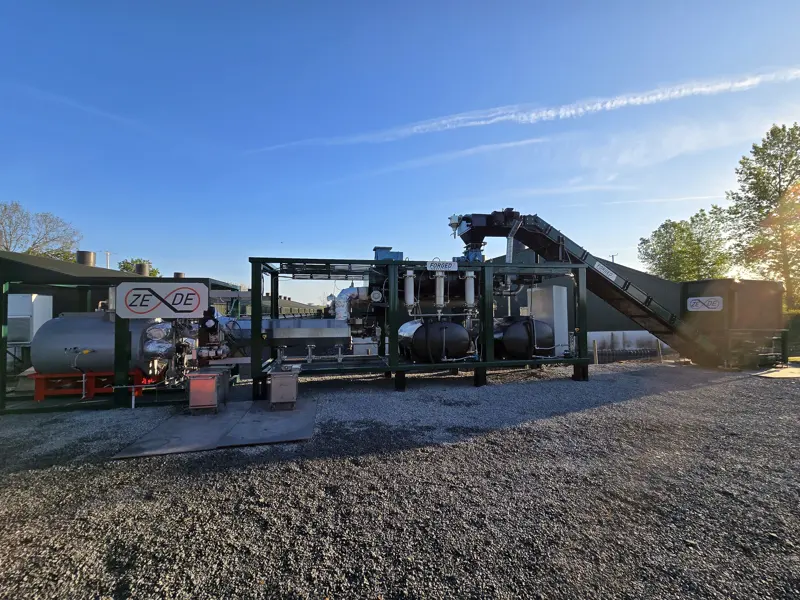
Consistent heat is usually limited by fuel cost. ZEDE turns a site’s own litter into heat delivered to the existing hot-water system, so heat and ventilation can be run to litter-moisture targets for the whole crop.
Read next: Drying layer manure at source
Sources
- Groot Koerkamp, Ammonia emission from aviary housing systems for laying hens (Wageningen, 1998)
- Gfeller, Valach et al., Bern University of Applied Sciences: floor heating and heat exchanger in broiler housing (EGU24-19295)
- Aviagen, Ross Broiler Management Handbook (2025)
- Defra, Code of Good Agricultural Practice for reducing ammonia emissions
- Defra, Code of Practice for the Welfare of Meat Chickens and Meat Breeding Chickens (2018)
- Council Directive 2007/43/EC laying down minimum rules for the protection of chickens kept for meat production
- Smith et al. (2016), Impact of direct and indirect heating systems in broiler units, Journal of Integrative Agriculture 15(11)
- Aviagen, recommended drinking guidelines: water to feed ratio 1.6–1.8:1
Psychrometric and equilibrium figures are calculated from standard relations. The interactive graphics are illustrative models of the mechanism; site conditions vary with litter, diet and drinker system.