Most of a crop’s water arrives after the heating goes off. ZEDE keeps it on.
Forged Innovation · 30 September 2026 · 6 min read
Day−3Preheat
Conventional heating
Heat going in (average)0 kW
ZEDE Heat
NH3Ammonia Generation Suppression Mode
Heat going in (average)0 kW
Extra water carried out of the litter0 m³
Conventional
0 m³
ZEDE Heat
0 m³
ZEDE Heat + heat exchanger
0 m³
Water drunk after day 21
0 m³
~90%less ammoniaSwiss trial
Dry litter stops ammonia forming
Ammonia forms when wet litter lets microbes break down uric acid. Keep the litter dry for the whole crop and there is little to form. A Swiss trial of heat with a heat exchanger and floor heating recorded around 90% lower ammonia emission (preliminary figures).
ZEDE Heat on: waiting for the growing phase
Fuel bought so far0 MWhconventional0 MWhZEDE Heat
72%
of the water is drunk while the heating is off
21
the day conventional heating is switched off
2–3×
the heat a crop uses, in its own litter
270 kW
of ZEDE heat to hot water, enough for preheat
Why it matters
Dry litter means better air, healthier feet and less ammonia formed in the first place, and the Defra welfare code already requires it. But about 72% of a crop’s water is drunk after day 21, when conventional heating has stopped. Heat after that point has always meant buying fuel. How water drives ammonia →
Heat input to a two-house, 56,000-bird site, kWConventional schedule (heaters cycle within it)Heat from the site’s own litter (average; dashed = plant output)Water drunk per bird per day, mLShaded: the ~72% of the crop’s water drunk after day 21
Day of crop (preheat from day −3)
The heat is already on site
A ZEDE 300 turns a site’s own litter into 260–270 kW of hot water, about 2 kWh per kilogram, feeding the heating the houses already have.
Try your own numbers
How much heat is in your litter?
Litter per crop—
Heat from that litter—
Heat a conventional crop uses—
Water drunk after day 21—
Litter heat
Heat used today
Estimates: ~1.2 kg litter per bird per crop at ~32% moisture; ~2 kWh to hot water per kg of litter (ZEDE 300 in operation); 0.87–1.21 kWh per bird used on a conventional schedule; water at 1.6–1.8 L per kg of feed.
The heat budget for a 56,000-bird site
Per crop
Heat
Basis
Conventional heating used
~49–68 MWh
Schedule above, heaters cycling roughly half to two-thirds of the time
Heat available from the site’s litter
~130–145 MWh
64–70 t litter at ~32% moisture, ~2 kWh to hot water per kg
Plant output
260–270 kW
ZEDE 300, enough for preheat on its own; the litter runs it at full output for about three weeks a crop
Averaged over the crop
~145–165 kW
From preheat to about day 34
Spare heat after today’s heating
~60–95 MWh
Enough to evaporate up to roughly 90–140 m³ of water
Latent heat of about 0.68 kWh per litre; evaporation figures are upper bounds. Energy in the biochar itself is not counted.
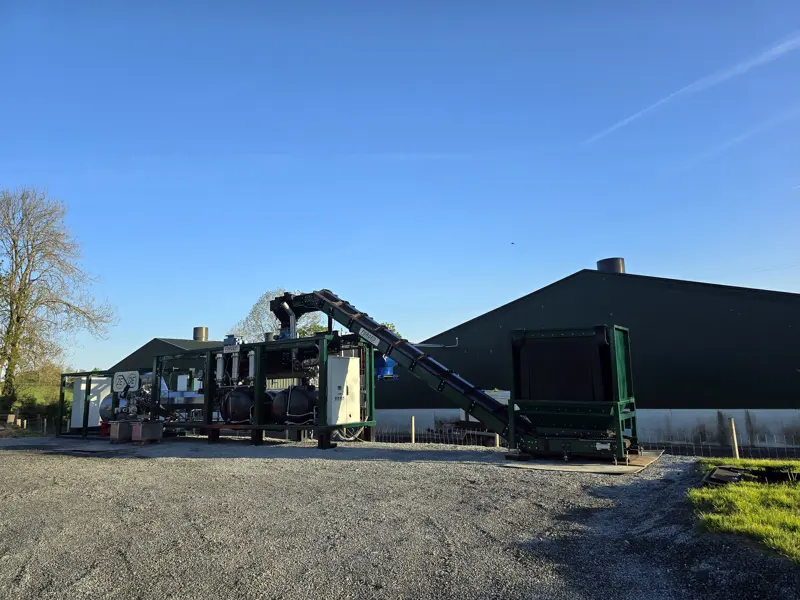
On site: the plant sits next to the houses it heats.Heat is delivered to a hot-water loop that feeds the existing heating.What leaves the plant: a dry, stable biochar.
What changes in the house
Heat on targetHeat and air set by litter moisture and humidity, not fuel cost
Dry to the endThe late-crop moisture load is met with heat instead of building up
Fresher airHigher air exchange at a comfortable temperature
Better performanceBirds in drier, fresher conditions use their feed well
Less ammonia formedDry litter keeps the conditions that form it from developing
No heating billPlus a stable biochar from the litter
Evidence: an SRUC analysis found birds on litter-heated farms sold 0.08–0.15 kg heavier and 1.3–1.9 days sooner than on gas-heated farms.
Stretching the heat further
Add an air-to-air heat exchanger and each kWh of ZEDE heat moves about 2.5 times as much winter air. Feed floor heating from the same loop and litter dries from underneath: a Swiss trial of that combination saw ammonia around 90% lower, with feed conversion unchanged.
Heat exchanger numbers, winter conditions
56,000-bird site
Heat to warm the air per litre removed
Water the spare litter heat can carry out
Without heat recovery
~0.8 kWh
~75–125 m³
With a heat exchanger at 60%
~0.3 kWh
~195–310 m³
Outside 5 °C / 90% RH, house air leaving at 20 °C / 70% RH; spare heat 60–95 MWh a crop. Upper bounds. Late-crop water load about 270–300 m³.
Design points
One plant, several houses. At 260–270 kW a ZEDE 300 handles a preheat on its own, and its heat can be scheduled across houses and into the late crop.
Existing or new. Retrofit with hot-water heaters and a heat exchanger; design floor heating into new builds.
Litter storage between crops. This crop’s litter heats the next, so it needs dry, covered storage and reliable handling.
Control on measured targets. Humidity and litter moisture should drive the extra heat.
Free measures first. Drinker height, line pressure and nipple choice reduce spillage at source.
Questions we are asked
Doesn’t more ventilation just vent the ammonia outside?
No. The ammonia leaving a house is its concentration multiplied by the airflow. Warm air that keeps the litter below the conditions microbes need means less ammonia forms in the first place, so less leaves, whatever the airflow. The aim is not more air for its own sake, but enough warm air to keep the litter dry.
Doesn’t adding heat increase ammonia?
Heat does not form ammonia. It speeds the release of ammonium that has already formed in the litter during a period when it was allowed to get wet. When heat and ventilation run consistently from placement, the litter stays dry, the store of ammonium never builds, and there is little for heat to release.
A study found indirect heating made no difference to ammonia. Why would this?
That study compared indirect and direct heating on the same heating pattern, front-loaded and tapering off as the birds grew. Changing the heat source without changing when heat is applied leaves the drying gap in place. What changes the outcome is heat and ventilation continuing through the whole crop, controlled to litter moisture and humidity.
How much heat does the litter actually provide?
Our ZEDE 300 delivers 260–270 kW to hot water from about 130 kg an hour of litter at 32% moisture, roughly 2 kWh of heat for every kilogram of litter. A two-house site of 56,000 birds produces 64–70 tonnes of litter a crop, worth about 130–145 MWh of heat, against roughly 49–68 MWh used on a conventional schedule.
Can it cover the preheat?
Yes. At 260–270 kW a ZEDE 300 handles a preheat on its own, and has done so in operation. The litter from a two-house site then keeps it at full output for about three weeks of each crop, with heat scheduled across houses and into the late crop as needed.
Will it work with my existing heating?
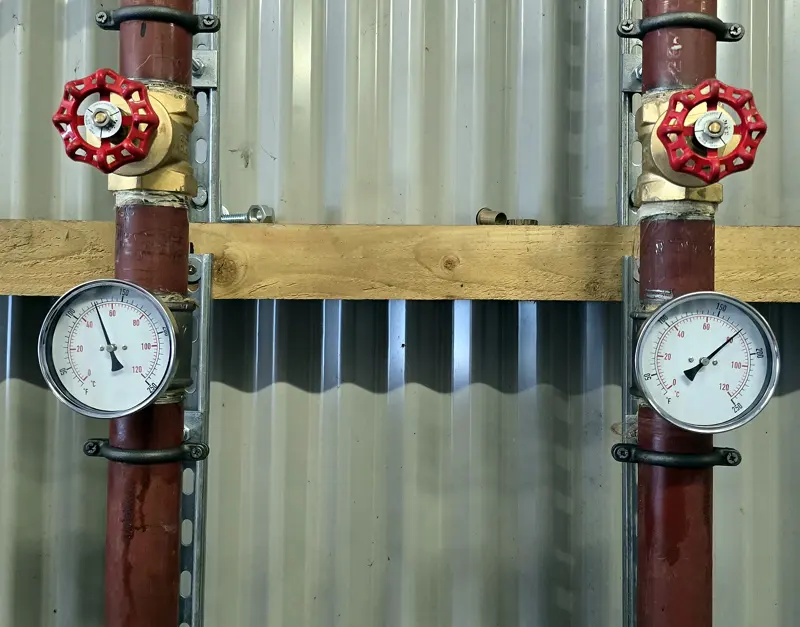
Most broiler houses already heat with hot water through radiators or fan heaters. Heat from the litter is delivered to a hot-water loop, so it replaces the fuel at the boiler and nothing changes inside the house.
Does it suit existing houses or only new builds?
Both. In an existing house the practical package is hot-water heaters on the litter-heat loop, with an air-to-air heat exchanger to stretch the heat further. In a new build, floor heating from the same loop is worth designing in from the start.
Does extra heat and ventilation affect bird performance?
The UK and European evidence is positive. An SRUC analysis of farms heated by litter-fired indirect systems found birds sold heavier and sooner than on gas-heated farms, and a Swiss trial of floor heating with a heat exchanger saw ammonia fall by around 90% with feed conversion unchanged.
When is it hardest to keep litter dry?
On mild, damp days rather than cold ones. When the outside air is already nearly as wet as the house air, each cubic metre of ventilation can carry very little moisture away. Warming the house air or the litter surface is what restores the drying capacity.
What happens to the litter?
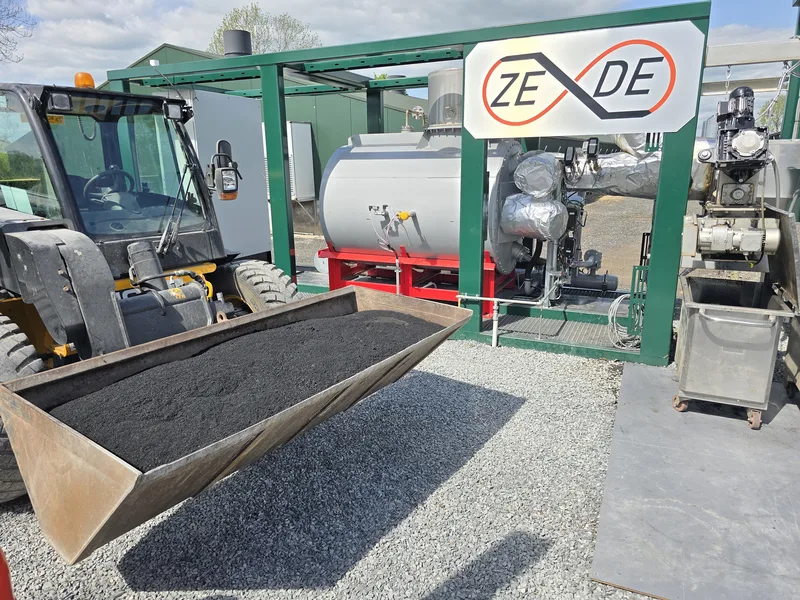
It is processed on site into heat and a dry, stable biochar. The biochar keeps the nutrients in a form that stores and travels, so the litter becomes a product rather than a material that has to be moved at a cost.
Where is litter stored between crops?
Litter from one crop heats the next, so it needs dry, covered storage and reliable handling into the plant. We design the storage, infeed hoppers and augers as part of the system.
What is the payback?
It depends on your fuel costs, what you currently pay to move litter, site layout and how the heat and biochar are used. A site feasibility study works that out on your own figures before you commit.
How we can help
Heat the house with its own litter
ZEDE processes poultry litter on the farm and recovers the heat to a hot-water loop that plugs into existing house heating, from 300 kW to 6 MW. We design the litter storage and handling, the heat and mass balance and the controls around your houses and crop cycle.
Heating schedule and heat demand reflect conventional practice on a two-house broiler site we work with, based on seven years of the grower’s records. ZEDE output is from operation on broiler litter at about 32% moisture. The day-by-day graphic is illustrative.