

What is happening
In written evidence to Parliament in March 2026, Melton Renewable Energy said its plants “process more than 600,000 tonnes of poultry litter each year”, that Renewables Obligation support expires from 2027, and that it expects to begin consultation on closures from December 2026, with “closure of sites from as early as April 2027”. In September 2026 it was reported that the government had declined transitional support.
The routes, and how much more each can take
| Route | Capacity | Assessment |
|---|---|---|
| Anaerobic digestion | Limited | High ash and nitrogen make litter a demanding digester feed; taken as a co-substrate in limited proportions. |
| Land application | Governed by nutrient rules | A valuable fertiliser, limited by nutrient management plans and available land. |
| Export | Subject to decisions elsewhere | Depends on rules set by others; the June 2026 pause on imports into the Republic of Ireland showed how quickly that can change. |
| Mushroom compost | Finite, largely committed | A long-standing outlet at modest scale. |
| New combustion plant | None consented at this scale | The subsidy expiry also removes the support that made new ones viable. |
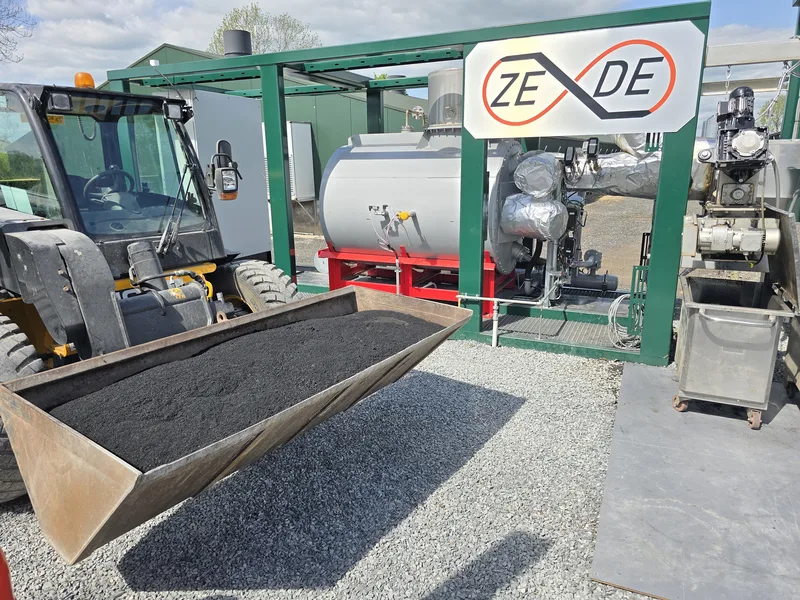
| On-farm drying and pyrolysis | Modular, farm by farm | Installed one holding at a time, in months rather than years. |
A replacement plant of comparable scale is a decade-long project. A gap measured in months is better met by many smaller installations, added as individual farms decide.
What it means for farm businesses
When capacity is short, whoever holds it sets the price, and haulage is paid on every tonne of water moved. Producers who can dry litter or process it on site are in a stronger position whatever happens. Turned into heat for the farm and a dry, stable biochar, litter’s value stays with the producer.
Practical steps now
- Know your outlet. When does your current arrangement end, and what does it depend on?
- Cost the alternatives. Gate fees, haulage and storage against what the material is worth to you.
- Take the water out. Drying makes every other option cheaper.
- Look at processing on site. Heat for the farm and a stable biochar product.
- Start the paperwork early. Planning and permitting take longer than building.
Process litter where it is produced
ZEDE turns poultry litter and manure into renewable heat and stable biochar on the farm, from 300 kW to 6 MW. Our infeed hoppers and augers keep wet, stringy litter moving, and a Material Handling Audit shows what your site needs.
Read next: Heat the whole crop with its own litter
Sources
- UK Parliament, Written evidence submitted by Melton Renewable Energy UK Ltd (PWC0053), March 2026
- Bureau of Investigative Journalism, report on poultry-litter power stations, 9 September 2026
General information based on public sources at the date of publication. The calculator gives estimates, not a quotation.